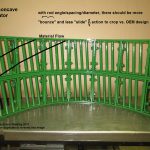
Combine maintenance ROI is not a cost line on your budget, it is a harvest investment. Most farmers can quote the price of a wear part in seconds. The best operators take it one step further and ask a better question. What is the cost of not replacing it before harvest starts?
Harvest does not punish you for what you spent in winter. It punishes you for what you skipped. A tired component that fails in July is not just another repair. It is a lost weather window, a crew standing still, and a machine that forces you to back off when crop conditions are finally right.
In a season measured in narrow weeks, reliability and performance are not nice extras. They are the difference between finishing strong and fighting through avoidable setbacks.
Combine maintenance ROI you can measure
Return on investment is simple. Return is what you gain or stop losing. Investment is the parts, labor, and time you put in now. For combines and threshing systems, that return usually shows up in six places.
-
Reduced downtime
-
Reduced engine load
-
Reduced fuel consumption
-
Cleaner grain in the tank
-
Less rotor loss
-
Increased machine capacity
When you think about combine maintenance ROI, start with what you protect. You are buying back harvest hours, preserving grain quality, and keeping capacity available for the few days when everything lines up.
Six ways maintenance pays you back
1. Reduced downtime buys harvest hours
Preventive maintenance lowers breakdown risk and reduces the severity of failures when they do happen. Emergency repairs almost always cost more. They happen under pressure, with limited time to diagnose, and often after secondary damage has already occurred.
The ROI question is straightforward. How many harvest hours does this winter work protect? Even one saved day in a tight weather stretch can be worth far more than the maintenance bill. Harvest windows are short and the weather does not wait.
2. Lower engine load restores designed performance
As wear parts age, tolerances open up and crop flow becomes uneven. The combine compensates by working harder. Load increases through the rotor, feeder, belts, and drives. In the cab, it feels like a machine that fights the crop instead of processing it smoothly.
Refurbishment brings the crop path back to designed performance. When flow is consistent, the system does the work efficiently, not by brute force. You are preventing failures and restoring how the machine is supposed to run.
3. Fuel savings add up across acres
Fuel savings are one of the clearest ROI signals because the math is clean. A tighter threshing and separation system reduces engine load. As a result, fuel use per acre drops.
A few cents per acre may not look dramatic on a single field. Stretch that over thousands of acres and it becomes a real number. Unlike yield, fuel savings show up immediately, regardless of markets or weather.
4. Cleaner grain means more sellable bushels
Better harvests are not only about more bushels. Better also means more sellable bushels. Worn threshing components create more foreign material, more cracked kernels, and poorer separation. That hurts dockage, grade, storage performance, and the final cheque.
Refurbishment restores separation efficiency so the grain arriving in the tank is cleaner and more intact. You see it in the sample, and you gain confidence to push throughput when conditions are right.
5. Less rotor loss keeps paid-for kernels
Rotor loss rarely shows up as a line item you can point to, but it always shows up in profitability. When wear parts are tired and flow is uneven, the combine cannot separate effectively at high throughput. You push to maintain pace and more grain leaves with the residue.
That is not an operator problem. It is a system performance problem. Winter refurbishment tightens the system back up. With the right parts in the right places, you can keep capacity without sacrificing separation. Less grain out the back, more in the tank. You already paid to grow those kernels, so the ROI is keeping them.
6. Capacity stacks every return
Capacity is where all five returns stack into a sixth. A properly refurbished combine runs smoother, stays loaded more evenly, and holds separation efficiency at higher rates. That gives you the ability to drive faster and cut more acres per hour without paying for it in loss or sample quality.
In practical terms, increased capacity means you capitalize on good weather instead of being limited by machine performance. You shorten the harvest timeline, lower late season risk, and reduce the fatigue that comes with long, drawn out runs.
Why winter refurbishment multiplies returns
Winter is the right time because it gives you something harvest never will. You have time to do the job properly. You can inspect wear patterns without pressure, replace what is tired before it becomes expensive, and set the machine up so it runs smoothly and predictably before the first acre is cut.
This is not about overbuilding a combine. It is about protecting the profitability of your harvest window with smart, strategic decisions. Winter work is when combine maintenance ROI is easiest to lock in and easiest to measure.
The smart farmers treat maintenance the same way they treat land improvements, seed selection, or fertility plans. It is not a cost. It is a lever.
Turn maintenance into a harvest investment
Winter refurbishment is how you buy reliability, efficiency, cleaner grain, less rotor loss, and higher capacity when it matters most. That is ROI you can measure in fuel, time, quality, and bushels.
At Sunnybrook, everything we design is built for that outcome. We want fewer headaches, cleaner samples, less loss out the back, more acres per hour, and a better harvest every year. Treating service as combine maintenance ROI, not expense, is how you protect every acre you farm and every bushel you grow.